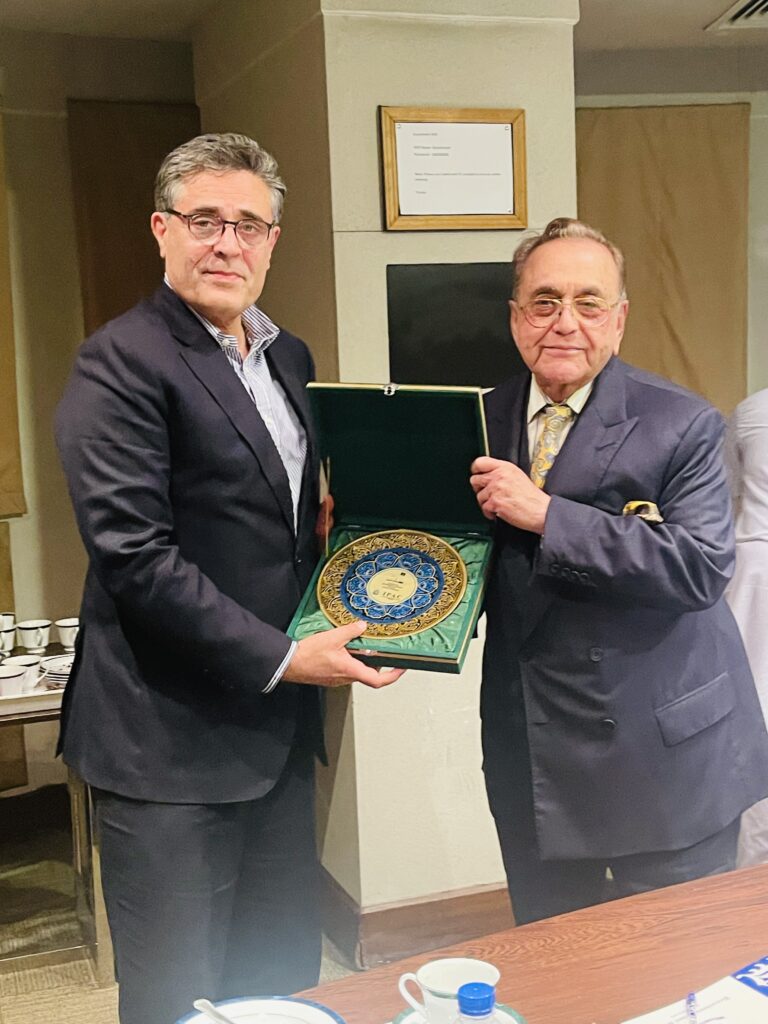
The Institute of Peace and Connectivity (IPAC) hosted Ambassador Khalil Hashmi, Pakistan’s Ambassador to the People’s Republic of China, for a substantive engagement with the IPAC Board of Directors in Islamabad. Ambassador Hashmi, one of Pakistan’s most distinguished career diplomats and a former Permanent Representative to the United Nations, brought a uniquely authoritative perspective on the state of Pakistan–China relations and the vast commercial, industrial, and human potential that remains untapped between the two countries.
A central theme of Ambassador Hashmi’s engagement was the imperative of deepening private sector-to-private sector linkages between Pakistan and China. He observed that while the governmental and strategic dimensions of the relationship are well established, the business communities of the two countries remain insufficiently connected. Pakistani small and medium enterprises have enormous scope to access Chinese value chains, manufacturing ecosystems, and the vast Chinese consumer market — particularly through digital platforms such as Alibaba, JD.com, and Pinduoduo, which are progressively opening to international vendors. He called on IPAC and Pakistan’s business community to work actively to bridge this gap through trade missions, B2B matchmaking, and sustained institutional outreach.
Ambassador Hashmi placed special emphasis on skills development as a transformative frontier of Pakistan–China cooperation. China’s extraordinary experience in vocational and technical education — including its network of world-class polytechnic institutions and industry-embedded training programmes — offers Pakistan a replicable model for developing the skilled workforce that its economy urgently needs. He highlighted the potential for structured Chinese language training, technical certification programmes, and joint vocational institutes under the CPEC framework as vehicles for building human capital at scale. Pakistani youth, he argued, represent an extraordinary asset that can be leveraged through systematic skills partnerships with Chinese institutions and enterprises.
On the economic and trade dimensions, Ambassador Hashmi was candid about the need to rebalance a relationship currently characterised by a significant trade deficit in China’s favour. He pointed to Pakistan’s proven strengths in agriculture — including mangoes, Basmati rice, citrus, seafood, and halal meat products — as natural entry points for expanding Pakistani exports to China’s enormous and increasingly affluent consumer base. He also cited Pakistan’s growing information technology sector, its pharmaceutical industry, and its textile and leather goods as sectors with significant export potential that remain underexploited in the Chinese market. The Special Economic Zones being developed under CPEC Phase II were highlighted as critical platforms for attracting Chinese industrial investment, generating employment, and enabling technology transfer to Pakistani industry.
The IPAC Board engaged Ambassador Hashmi on a range of additional dimensions, including educational exchange, the deepening of financial connectivity through Pakistani bank branches in China and yuan-rupee trade settlement mechanisms, tourism potential given China’s status as the world’s largest outbound travel market, and cultural diplomacy as a foundation for sustainable long-term partnership. Ambassador Hashmi underscored that Pakistan’s unique civilisational depth, its natural landscapes, and its shared Islamic heritage with significant communities in western China offer avenues for cultural cooperation that have yet to be seriously developed. The session concluded with IPAC Chairman Mr. Khurshid Mahmud Kasuri presenting Ambassador Hashmi with a commemorative IPAC shield in recognition of his distinguished service to Pakistan–China relations.
KEY AREAS OF DISCUSSION
🏭 Private Sector & Business Community Linkages
Connecting Pakistani SMEs to Chinese markets and value chains; B2B trade missions; leveraging Chinese e-commerce platforms (Alibaba, JD.com) for Pakistani exports; chambers of commerce partnerships and business delegation exchanges.
🎓 Skills Development & Vocational Training
Replicating China’s vocational and technical education model in Pakistan; Chinese-language training for Pakistani professionals and youth; joint polytechnic institutes under CPEC; industry-embedded certification programmes; training of trainers.
🌾 Agricultural Exports & Food Trade
Expanding Pakistani agricultural exports — mangoes, Basmati rice, citrus, halal meat, seafood — to China’s vast consumer market; phytosanitary standards compliance; cold-chain logistics under CPEC corridors; food processing joint ventures.
🏗️ CPEC Phase II — Industrial & Technology Transfer
Moving beyond infrastructure into Special Economic Zones, manufacturing investment, and technology transfer; Chinese industrial relocation to Pakistan; joint ventures in textiles, leather, chemicals, and IT; renewable energy cooperation.
💻 Digital Economy & IT Cooperation
Pakistan’s growing IT sector as an export engine to China; fintech collaboration; yuan-rupee settlement mechanisms; digital connectivity infrastructure; Pakistani tech startups accessing Chinese venture capital and incubator ecosystems.
🌏 Education, Culture & People-to-People Ties
Chinese government scholarships for Pakistani students; university partnerships; tourism development for Chinese visitors to Pakistan’s natural and cultural heritage; cultural diplomacy drawing on shared civilisational depth and Islamic heritage ties with China’s Muslim communities.