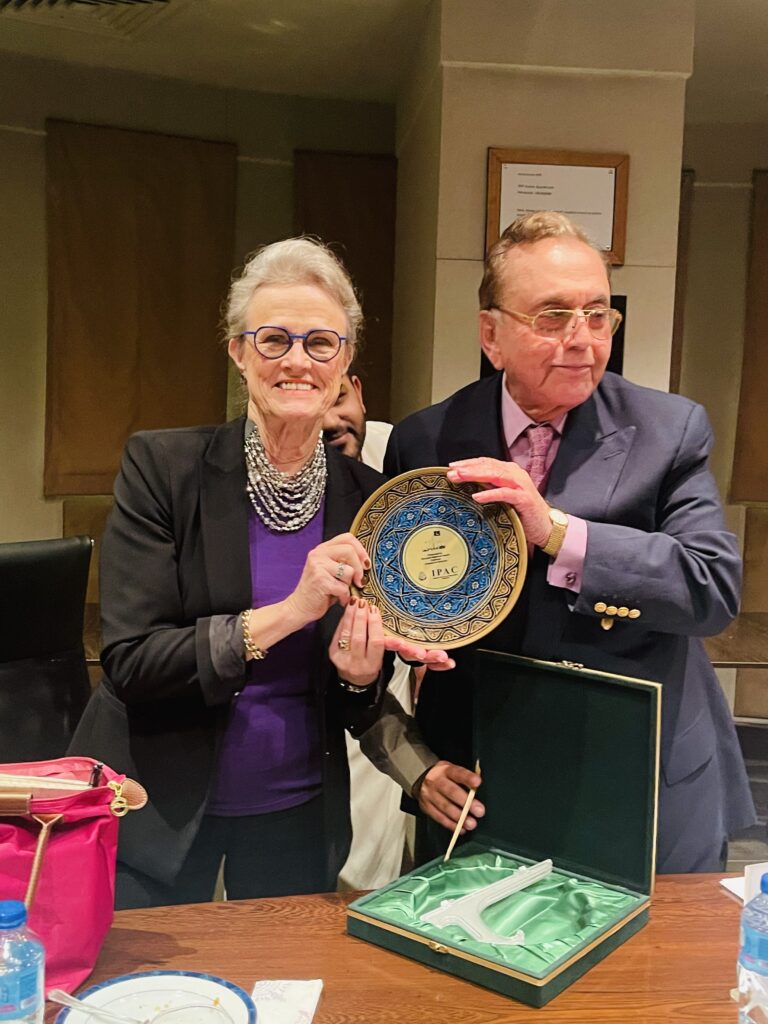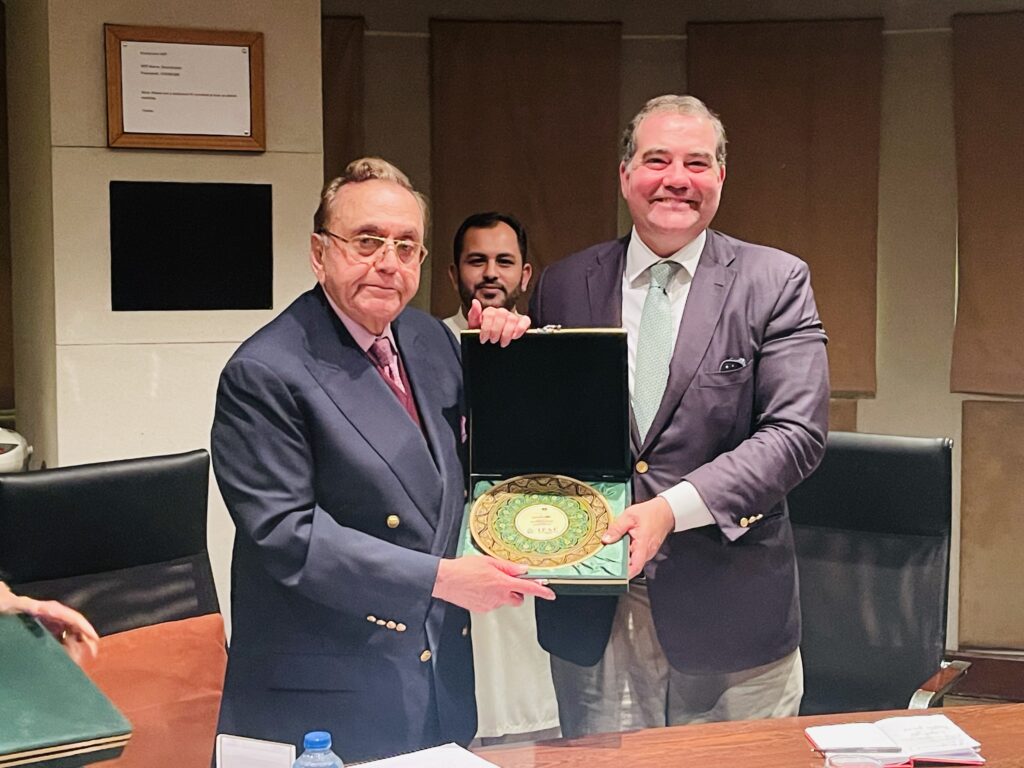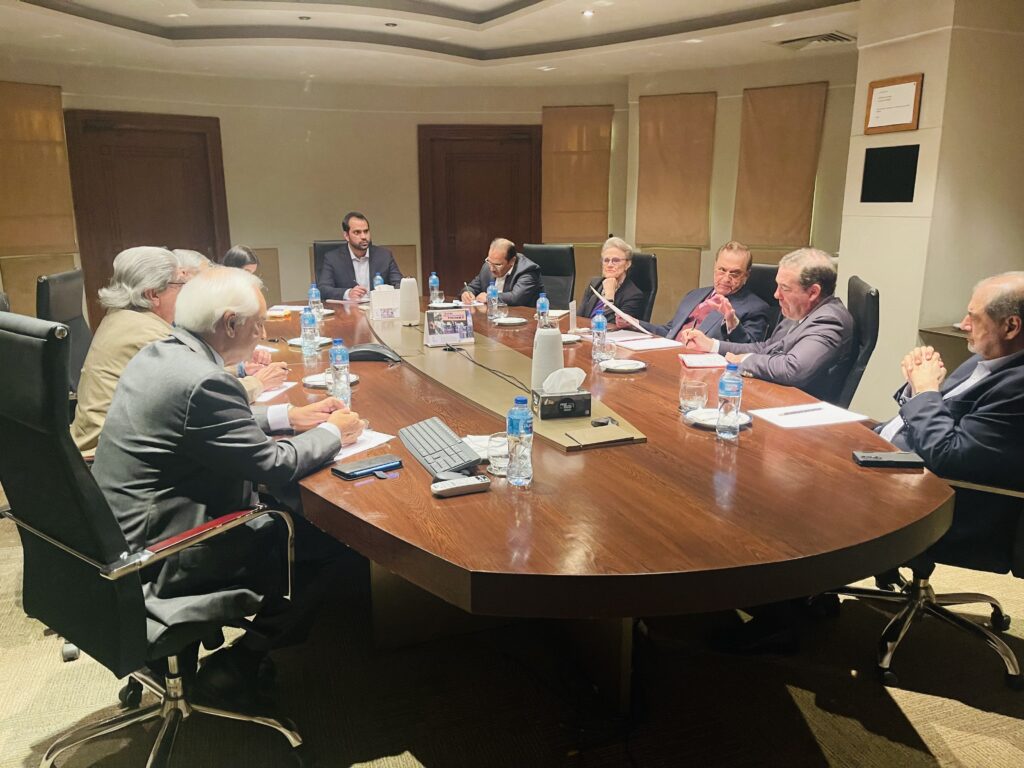
IPAC Board of Directors in session with Ambassador Robin Rafael and Mr. Daniel F. Runde, Senior Vice President, CSIS — Lahore, November 2024
The Institute of Peace and Connectivity (IPAC) convened a substantive high-level dialogue with two distinguished American voices in foreign policy and strategic studies: Ambassador Robin Rafael, former United States Ambassador to Pakistan and a recognised authority on South Asia diplomacy, and Mr. Daniel F. Runde, Senior Vice President and William A. Schreyer Chair in Global Analysis at the Center for Strategic and International Studies (CSIS) in Washington DC. The session brought together the full IPAC Board of Directors in a frank and wide-ranging exchange on the future of Pakistan–United States relations.
The centrepiece of Mr. Runde’s intervention was an emphatic call for the United States to recognise and act upon Pakistan’s extraordinary mineral endowment. He highlighted that Pakistan sits atop world-class deposits of copper, gold, and rare earth elements — resources of critical strategic importance as the United States works to diversify global supply chains away from single-source dependence. Reko Diq in Balochistan alone ranks among the largest undeveloped copper-gold deposits on earth. Mr. Runde argued that with the right investment framework, transparent governance structures, and targeted US engagement through instruments such as the Development Finance Corporation (DFC), Pakistan could emerge as a pivotal supplier of the critical minerals that underpin clean energy, defence, and advanced technology industries.
Ambassador Robin Rafael brought to the discussion decades of firsthand experience navigating the complexity of the US–Pakistan bilateral relationship. She underscored that the foundation for a more durable partnership must be built on consistent, long-term engagement rather than transactional cooperation driven by immediate strategic imperatives. She stressed the importance of broadening the relationship beyond its traditional security frame to encompass trade, investment, education, and people-to-people connectivity — areas where both nations have much to gain and where the large, accomplished Pakistani-American diaspora can serve as a powerful bridge.
The IPAC Board engaged on several additional dimensions of mutual interest, including the trajectory of Afghanistan and its implications for regional stability, the scope for expanded US–Pakistan trade and market access, cooperation in agriculture and food security, and the role of multilateral institutions in supporting Pakistan’s economic reform agenda. Both guests emphasised that Pakistan’s strategic location at the crossroads of South Asia, Central Asia, and the Gulf makes it an indispensable partner for any coherent United States strategy in the wider region.
IPAC Chairman Mr. Khurshid Mahmud Kasuri welcomed the spirit of candour and the depth of expertise that Ambassador Rafael and Mr. Runde brought to the table. He reaffirmed IPAC’s conviction that independent, evidence-based track-two dialogue of precisely this kind — frank, substantive, and beyond the transactional — is essential to building the architecture of a lasting Pakistan–US partnership. The session concluded with IPAC presenting a commemorative shield to Mr. Runde in recognition of his sustained engagement with Pakistan and his advocacy for deeper bilateral cooperation.
KEY AREAS OF DISCUSSION
⛏️ Critical Minerals & Rare Earth Resources
Pakistan’s copper, gold, and rare earth deposits as a strategic US–Pakistan economic frontier; Reko Diq development; DFC investment frameworks.
💹 Trade, Investment & Economic Reform
Expanding bilateral trade beyond traditional sectors; US private sector entry into Pakistani markets; IMF programme sustainability and structural reform.
🌍 Regional Stability & Afghanistan
Pakistan’s role as a stabilising force; implications of the Afghan situation for US interests; the importance of a stable, prosperous Pakistan to the wider region.
🤝 Track-Two & Institutional Engagement
The role of think tanks and independent institutions in sustaining dialogue through periods of diplomatic tension; IPAC as a platform for frank exchange.
🎓 Education, Diaspora & People-to-People Ties
The Pakistani-American diaspora as a bilateral asset; educational exchange programmes; building long-term societal connections alongside government-to-government ties.
⚡ Energy & Climate Cooperation
Pakistan’s renewable energy potential; US technical assistance in energy sector reform; clean energy investment as a vehicle for deeper bilateral engagement.
IPAC Board of Directors in session with Ambassador Robin Rafael and Mr. Daniel F. Runde, Senior Vice President, CSIS — Lahore, November 2024